

Generative AI is rapidly driving down the cost of video production.
Creating images. Creating video. Creating audio. AI is steadily replacing workflows that previously required specialized production environments.
Moving forward, will the true value expected of creative AI simply be "generating" even higher-quality video?
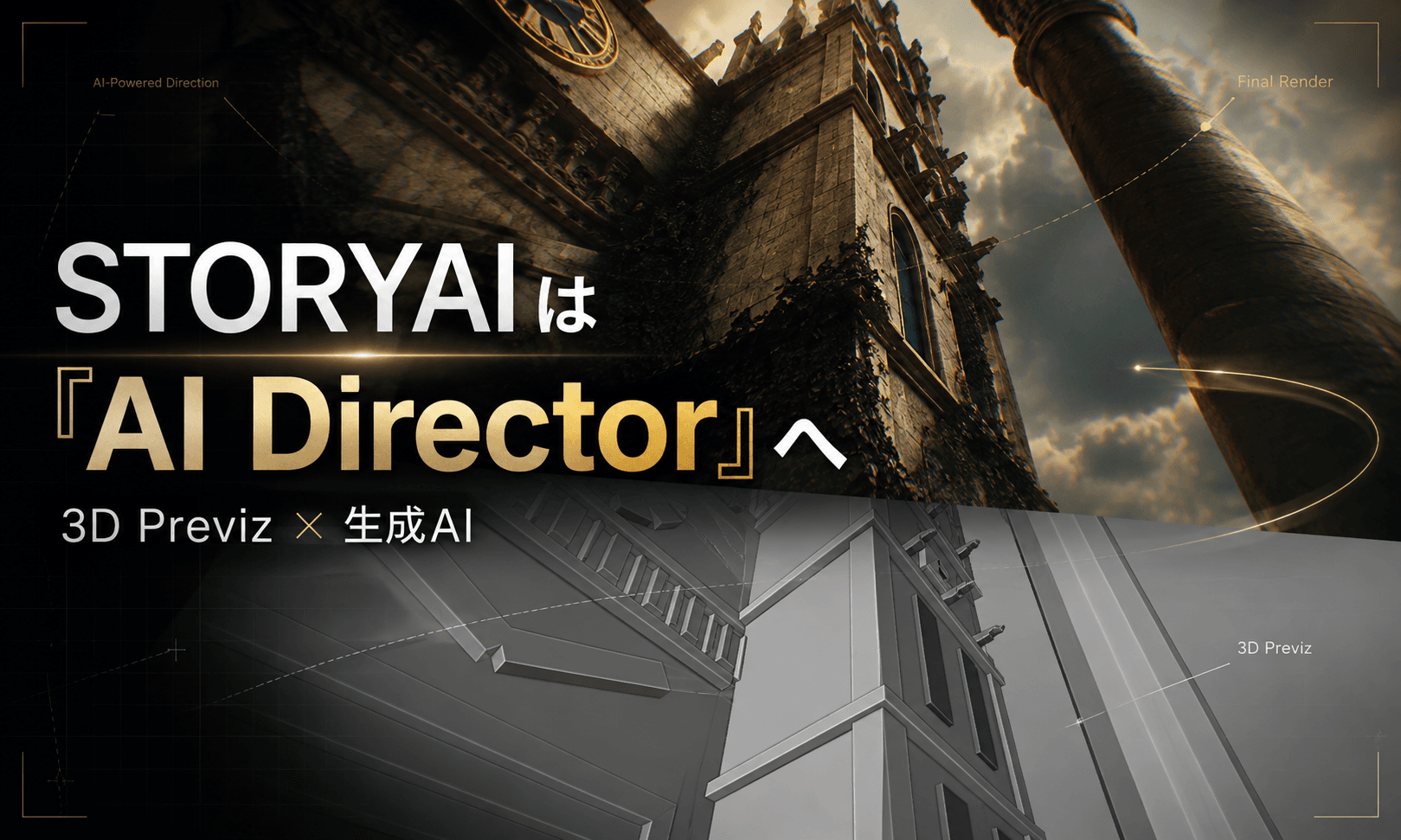
Observing the workflow shared by Lovis Odin—converting 3D video created in Blender into photorealistic footage using fal's Seedance 2.5—revealed a different possibility to me.
Namely:
Not an AI that merely generates, but an AI that directs the production process until the intended work is realized.
Let's consider what the next evolution of STORYAI could look like.
Building the Video in 3D, Leaving the "Look" to AI
Lovis Odin's workflow consists of two major Skills.
The first is a Skill that creates a 3D previz called a "Clay Scene" in Blender.
The crucial point here is that the 3D model does not need to be refined into a finished piece.
What 3D handles is the underlying structure of the video, such as:
- Composition
- Camera trajectory
- Object placement
- Scene timing
The Skill itself defines this philosophy as:
3D owns composition, camera and timing; the model owns the pixels.
In other words, there is a clear division of labor: 3D dictates composition, camera, and timing, while the generative model handles the pixels.
I believe this is a profoundly important concept.
When you leave video production entirely to generative AI, even if the imagery itself is stunning, you run into issues like:
"The camera doesn't move in the intended direction." "Building positions shift midway through." "Key subjects vanish from the frame."
To prevent this, you lock down the scene in 3D first, before bringing in generative AI.
Rather than having the AI invent the footage from scratch, its sole job is to translate predetermined direction into realistic visuals.
The Core of This Skill Isn't Actually "3D Generation"
What makes it even more intriguing is the architecture of the Clay Scene Skill.
First, it asks the user:
- What kind of world is this?
- What are the key landmarks?
- How should the camera move?
- What is the mood (time of day, weather, etc.)?
After that, it generates the scene in Blender.
However, it doesn't just arbitrarily place objects.
The Skill incorporates rules to establish a convincing visual structure—such as utilizing over 500 objects to maintain environmental density and constructing three distinct depth layers (foreground, midground, background).
For the camera as well, highly specific cinematic grammar is defined, including:
- Camera paths based on Bezier curves
- Point-of-interest (look-at) tracking
- Focal lengths between 28–35mm
- Subject frame coverage
- Foreground wipes
In short, the value of this Skill is not just its ability to operate Blender.
Embedded within it is directorial knowledge:
What makes a shot visually readable?What kind of camera work feels cinematic?
Even More Critical: The QC Loop
This workflow has another crucial feature:
It doesn't simply generate and stop.
It always runs QC (Quality Control).
It checks whether the camera collides with objects using ray casting and verifies that no abrupt velocity changes occur.
Furthermore, it generates 12 checkpoint images across the entire sequence to inspect:
- Framing
- Subject visibility
- Dead zones
- Duration of foreground wipes
If issues are found, it modifies the camera path and runs QC again.
The Skill expects around 2 to 4 iterations.
In other words, this workflow is not:
Generate
but rather:
Generate → Evaluate → Improve
This is where it deeply intersects with STORYAI.
Moving from 3D to Photorealism via AI
The 3D sequence produced by Clay Scene is passed to the next Skill: fal-video.
In this Skill, the first frame of the 3D video is first sent to Seedream 5 Pro to generate a photorealistic keyframe.
Even here, the AI is not given free rein.
The prompt explicitly instructs it to:
"Treat the base image as the ground truth for geometry and composition, repainting only the surface textures."
Additionally, it overlays the generated image with the original 3D frame at 50% opacity to verify that no double edges appear on buildings or structures.
If the structural geometry has shifted, it fails the check.
Then, that keyframe along with the 3D video is passed to Seedance 2.5.
Here too, it is instructed to:
Treat the 3D animation as the absolute reference for camera trajectory, timing, and architectural positioning.
Furthermore, the prompt is organized into temporal blocks such as:
[0-2s][2-4s][4-6s]
specifying what the camera does and what is visible on screen during each interval.
Through this process, the workflow achieves:
Locking down the cinematic direction in 3D, and using AI solely to make the textures photorealistic.
What STORYAI Can Do from Here
If we simply ported this mechanism directly into STORYAI, it would amount to nothing more than:
"Controlling Blender and video generation AIs from STORYAI."
However, there wouldn't be much point in STORYAI doing just that.
Where STORYAI truly belongs is one step further upstream.
Namely:
The layer that decides what the cinematic direction should be in the first place.
Story → Emotion → Camera
Suppose a user writes a scene like this:
The protagonist arrives at a ruined city for the first time. At first, they are overwhelmed by the sheer scale of the city. Midway through, they spot a colossal tower and feel dread. Finally, catching a glimpse of light atop the tower, they feel a glimmer of hope.
STORYAI's first step is not generating video.
It analyzes the story and converts it into an emotional curve:
0–8s: Awe / Overwhelm 8–20s: Fear 20–30s: Hope
Next, it translates each emotion into visual direction.
To convey "Awe":
Wide-angle lens. Low angle. Small subject framing. Massive structures dominating the frame.
To convey "Fear":
Slow push-in toward the tower. Temporarily occluding the line of sight with foreground buildings. Gradually guiding the gaze upward.
To convey "Hope":
Crane / elevate the camera. Increase the ratio of sky in the frame. Light emanating from the top of the tower.
In this way, it translates:
Narrative → Emotion → Cinematography
STORYAI Previz
If we package this concept into a product, I envision it as:
STORYAI Previz
All the user inputs is a script or scene idea.
From there, STORYAI carries out:
- Story Analysis
- Emotion Curve
- Scene Breakdown
- Shot Design
- Camera Design
- Blender Clay Generation
- Camera QC
- AI Look Development
- Video Generation
- Story / Emotion QC
- Auto Revision
In short:
"An AI that transforms screenplays into shootable, directed sequences."
"Creative QC": Something Only STORYAI Can Do
And this is the most critical aspect.
The Clay Scene Skill already features remarkably solid Technical QC:
- Does the camera collide with any objects?
- Is the velocity smooth?
- Does the composition hold up?
- Is the geometry preserved?
STORYAI can layer an additional stage of QC on top of this:
Creative QC.
It evaluates criteria such as:
- Emotion Match
- Story Beat Match
- Character Focus
- Visual Hierarchy
- Pacing
- Continuity
- Tone / Brand Match
For instance, even for footage that is technically flawless:
Target Emotion: Fear Emotion Match: 48 / 100
In this scenario, STORYAI diagnoses the cause:
While the camera movement itself is smooth, the tower is revealed too early, preventing adequate suspense from building up.
It then decides:
Delay the reveal by 3.2 seconds and add foreground occlusion.
And feeds this back into the Blender camera design.
This establishes a dual evaluation loop:
Technical QC × Creative QC
Not Generative AI, but an "AI Director"
Viewed this way, the arena where STORYAI should compete also shifts.
There is no need to build the foundational image generation models ourselves.
Nor is there a need to build video generation models ourselves.
Those will continue to evolve at breakneck speed on their own.
What STORYAI must possess is the judgment to answer:
What should be made?Why choose this specific direction?Does it align with the intended goal?What needs to be revised next?
In other words, if generative models are the Production Engine,
STORYAI operates above them as the
Creative Intelligence Layer
The Data That Truly Needs to Be Accumulated
This concept holds another major implication.
The data STORYAI should accumulate is not just raw generation history.
For example:
Target Emotion: Fear
↓
Camera: slow push-in
↓
Composition: subject 8%
↓
foreground occlusion: yes
↓
Reveal timing: 12.4s
↓
Finished Video
↓
Actual Viewer Emotion: Fear 82%
In essence, it accumulates data on:
"What directorial choices evoke what emotional responses?"
As this compounds over time, STORYAI can evolve from a service that merely brainstorms direction via LLMs into:
An AI that understands the relationship between human emotion and visual direction.
This creates a powerful bridge to the emotion analysis work STORYAI has already been pursuing.
Story → Camera → 3D → Film
What Lovis Odin's workflow makes clear is that the future of AI video production will not necessarily be:
Prompt → Video
Instead, it will likely evolve into a pipeline of:
Intent → Structure → Generate → Evaluate → Improve
Within this paradigm, what STORYAI can bridge is:
Story → Camera → 3D → Film
And in the long run, integrating:
Story Intelligence × Cinematic Grammar × Generative Models × Evaluation Loop
Looked at this way, STORYAI's ultimate goal is not to be "just another generative AI."
It is an AI Director.
A system where humans supply what they want to communicate, and the AI determines how best to express it as a piece of work, produces it, evaluates it, and refines it until it matches the creative intent.
This 3D previz × generative AI workflow shows that such a future is already well within reach.
Reference: https://x.com/OdinLovis/status/2089402645857657014?s=20 (Accessed August 19, 2026)